
In brief AI assistants like ChatGPT, Claude, Gemini, and Perplexity are increasingly the first stop for people researching a purchase, a partner, or a provider. Most brands have no visibility into what those assistants say about them, or whether they appear at all. This article explains how AI brand visibility works from a brand strategy perspective, what determines whether you show up (and how warmly), and how Something Familiar built SearchStack, a bespoke brand monitoring tool that tracks your presence across all four major AI assistants simultaneously. If you want to understand your brand's position in AI search and what to do about it, this is where to start.
What is AI brand visibility?
AI brand visibility is quickly becoming one of the least understood problems in marketing. Not because it’s complicated, but because most brands don’t yet know they can access and impact it.
Before we go any further, this article will use phrases like SEO, GEO, AEO, and LLM. If those mean nothing to you, don’t worry. SEO is how you show up in Google. GEO (Generative Engine Optimisation) and AEO (Answer Engine Optimisation) are how you show up in AI, different names for overlapping ideas that amount to the same thing in practice. LLMs are the AI systems doing the answering: ChatGPT, Claude, Gemini, Perplexity. If those already mean something to you, apologies for the detour! If you’re curious how we use AI in our creative process, our AI creative brief writing work is a good place to start.
When someone considers working with you, they’re typically trying to solve a problem. Increasingly, the first thing they do is ask an AI assistant rather than reach for a search engine. What they receive back could be a list of four or five names with context on each, and your prospect’s shortlist is already created before you’ve had a chance to prove your brand.
A handful of GEO tracking tools have emerged in the last 12 months but they’re built for enterprise budgets and without insight into your business. They explain what they are seeing, not why, and not what to do about it.
That gap, between knowing you have a brand visibility problem and knowing what it means for your specific brand positioning, is exactly what we wanted SearchStack to close. Instead of shoehorning external tools into our process, we built our own around how we deliver creative brand and digital strategy to our clients.
“If your customers use the internet, they’re encountering AI, whether through a direct ChatGPT search, a Google summary, an AI-generated extract, or a Perplexity answer. The question isn’t whether AI is part of your brand’s discovery journey. It’s whether you have any visibility into what it’s saying when it is.”
Rich Williams, Digital Director, Something Familiar
What SearchStack is
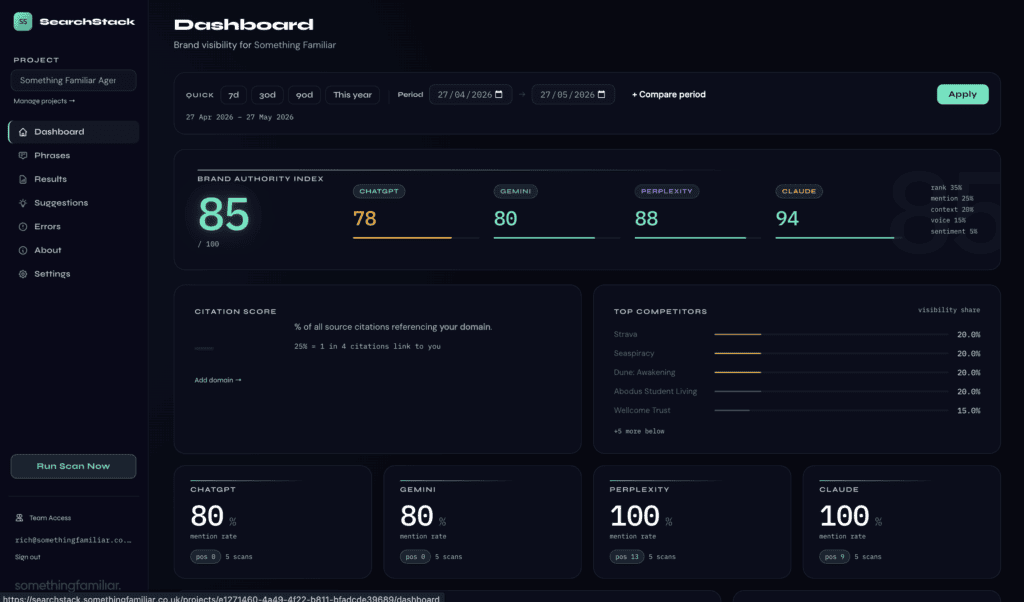
SearchStack is our brand monitoring tool that tests how your brand appears inside AI assistants. You give it a set of search phrases (the kinds of questions a real person might ask before choosing a software platform, booking a hotel, or hiring an agency) and it sends them simultaneously to the four major assistants.
It then reads what comes back: whether your brand appears in the answer, where in the response it sits, and whether the language around you is warm, neutral, or cool.
From there, it surfaces recommendations based on your broader brand strategy to improve your visibility, and can be configured to run automated measurements across the span of a campaign or marketing activity, giving you a clear before-and-after picture of your brand’s performance in AI search.
Why AI brand visibility matters, whatever your business
AI brand visibility isn’t a new discipline that appeared from nowhere. It’s an evolution of SEO, accelerated by the speed at which AI tools have embedded themselves into how people search, discover, and decide.
We noticed it from two directions at once. Prospective clients started telling us they’d found Something Familiar through ChatGPT or Perplexity. At the same time, existing clients began asking questions about their own AI visibility: whether their products and services were appearing, and whether what was being said about them was accurate. One client discovered that their products were being described incorrectly inside a major chat model. This is a serious brand challenge with no obvious fix if you can’t monitor what’s happening.
We experimented with the tools that exist in the market, and while some are useful, none of them fit the way we work or gave us the kind of strategic brand context our clients need. So we built our own.
How to show up in AI search: what we’ve learned about brand strategy and AI visibility
Once SearchStack was working, the first thing I did was point it at Something Familiar.
Some of it was reassuring. We appear well on Claude, less well on ChatGPT, somewhere in the middle on Gemini and Perplexity. Something Familiar turns up in answers about creative agencies, B Corps, Bristol-based studios. By the standards of a studio of our size, we’re visible.
But our sentiment score across the four assistants is neutral rather than positive. We’re mentioned, but not actively recommended. For commercial phrases like “best B Corp creative agency” we barely appear at all. That’s the kind of phrase that probably matters more than the brand-name ones. We rank stronger on direct queries than comparative ones, which in the new logic of how shortlists get drawn up, is probably the wrong way round.
Running SearchStack across a handful of other brands surfaced a few patterns worth noting.
AI assistants weigh authority sources very heavily. Think directories, third-party editorial, structured data, and listicles. The brands that show up well tend to be the ones that show up in places that look like consensus. The ones that don’t tend to be relying on their own website to do all the talking.
Showing up is one thing. Showing up warmly is another. Being present in AI search is largely about being where the citation graph is looking. Being described favourably is about what the surrounding language says about your brand on the sources that get cited, and that’s slower more deliberate brand strategy work.
Where AI brand visibility is built or lost:
- Editorial PR: being named in relevant published pieces
- Named-author content: bylined articles that build attributable expertise
- Client reviews on trustworthy platforms: Google Reviews, Trustpilot, and similar
The four assistants don’t necessarily agree with each other. A brand can sit top-three on Perplexity and not appear on ChatGPT for the same query. There isn’t a single AI search game. There are four, and they’re using different citation logic.
Why we built SearchStack rather than buying something off the shelf
Tools like Otterly, Profound, and SEM Rush’s AI visibility suite will tell you whether you’re appearing, with varying degrees of accuracy. But they’re built for generic enterprise use cases and they sit outside the strategic work rather than inside it.
That’s not how we work. At Something Familiar, the insight has to connect directly to the creative and brand strategy decisions we’re making with a client: which brand narratives are landing, which positioning claims are getting picked up, where a competitor is being described in language that should belong to you. An off-the-shelf tool gives you a dashboard. It doesn’t give you that. If you want to understand how we think about AI as a creative studio, that’s a longer conversation worth having.
So we built SearchStack to fit around our process rather than sit alongside it. The backend is Python and FastAPI, the database PostgreSQL, with four assistant APIs doing the heavy lifting at the centre. I sketched the architecture in plain English and directed it as it took form. There’s something quietly fitting about using an AI assistant to build a tool that monitors AI assistants.
Every SearchStack scan is interpreted through the lens of brand and digital strategy, not just reported back. You don’t get a readout. You get a brief.
Where this leaves things
Every brand already has a presence in the AI search layer. The only differentiator is whether you know what yours looks like.
SearchStack is now in active use with a small number of clients alongside our brand and digital work, with a clear set of actions at the end of every scan. Not just a report of where you sit, but a brand strategy brief on what to do about it.
If you’ve been wondering what an AI assistant says about your brand, we might have the answer. Get in touch.
Rich Williams is Digital Director at Something Familiar, a Bristol-based creative agency and B Corp.
SearchStack is a proprietary tool built at the studio, now in active use with a small group of clients.
FAQs
AI brand visibility refers to how, and how favourably, your brand appears in responses from AI assistants like ChatGPT, Claude, Gemini, and Perplexity. From a brand strategy perspective, it’s determined by what sources the assistant cites, the language used around your brand, and whether you appear at all when someone asks a question your brand should answer.
Showing up in AI search is largely determined by your presence in the sources AI assistants treat as authoritative: third-party editorial, directories, named-author content, and review platforms like Google Reviews or Trustpilot. Your own website carries less weight than most brands expect. Building presence on the platforms that feed the citation graph is the core of any brand-led GEO strategy.
SearchStack is a proprietary brand monitoring tool built by Something Familiar. It sends a defined set of queries to four AI assistants simultaneously (ChatGPT, Claude, Gemini, and Perplexity) and analyses the responses for brand mentions, position, and sentiment. Unlike generic GEO tools, it’s designed to connect AI visibility data directly to brand strategy decisions, so every scan ends with a brief, not just a dashboard.
Yes, often significantly. In our testing, brand presence varies considerably across the four major assistants. A brand can appear prominently on Perplexity and barely register on ChatGPT for the same query. Each assistant uses different citation logic, weights different source types, and produces different language around the brands it mentions. That’s why monitoring across all four gives a much more accurate picture of your actual AI brand visibility.
Because AI assistants are increasingly where brand perception is formed before a prospect ever reaches your website or speaks to your team. If the language an assistant uses about your brand is neutral, inaccurate, or absent entirely, that’s a brand strategy problem, not just a search problem. Understanding your AI visibility is now a foundational part of knowing where your brand stands.